Artificial Intelligence

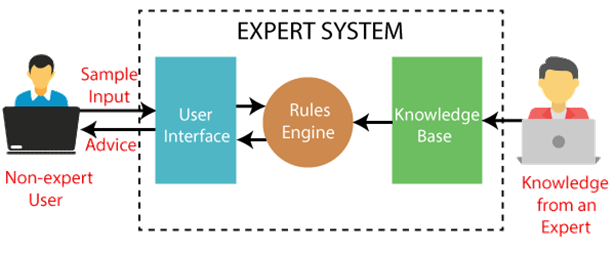
Expert Systems
Simulate human intelligence...
-
Are a form of AI.
- No active learning by machine.
- Rely upon predefined rules.
-
Frequent firing of a neuron strengthens the synapse between
connected neurons.
- Synaptic distance decreases; "tighter" connection along circuit.
- Close synapses are more likely to fire together.
- Aids in memory formation.
Machine Learning
Machine Learning allows computer systems to learn from data, without being explicitly programmed.
Even though neural networks are most discussed today, there are many types of machine learning.
Supervised Learning
- Supervised learning is a type of machine learning where the model is trained on a labeled dataset.
- The model learns to map inputs to outputs based on the correctly labeled data.
- The model is then used to predict the output for new inputs that it has not seen before.
Artificial Neural Networks
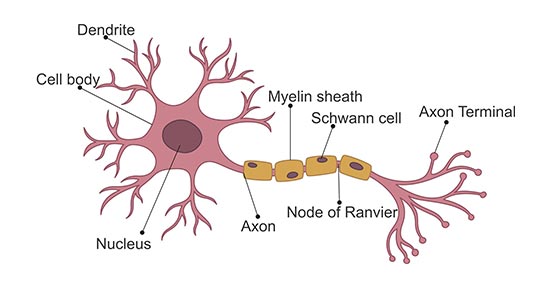
- Inputs are called "features" or "parameters"
- Each layer behaves like a function, transforming the previous layer.
- Complexity of function that can be learned depends on the architecture that's used.
Single layer perceptron
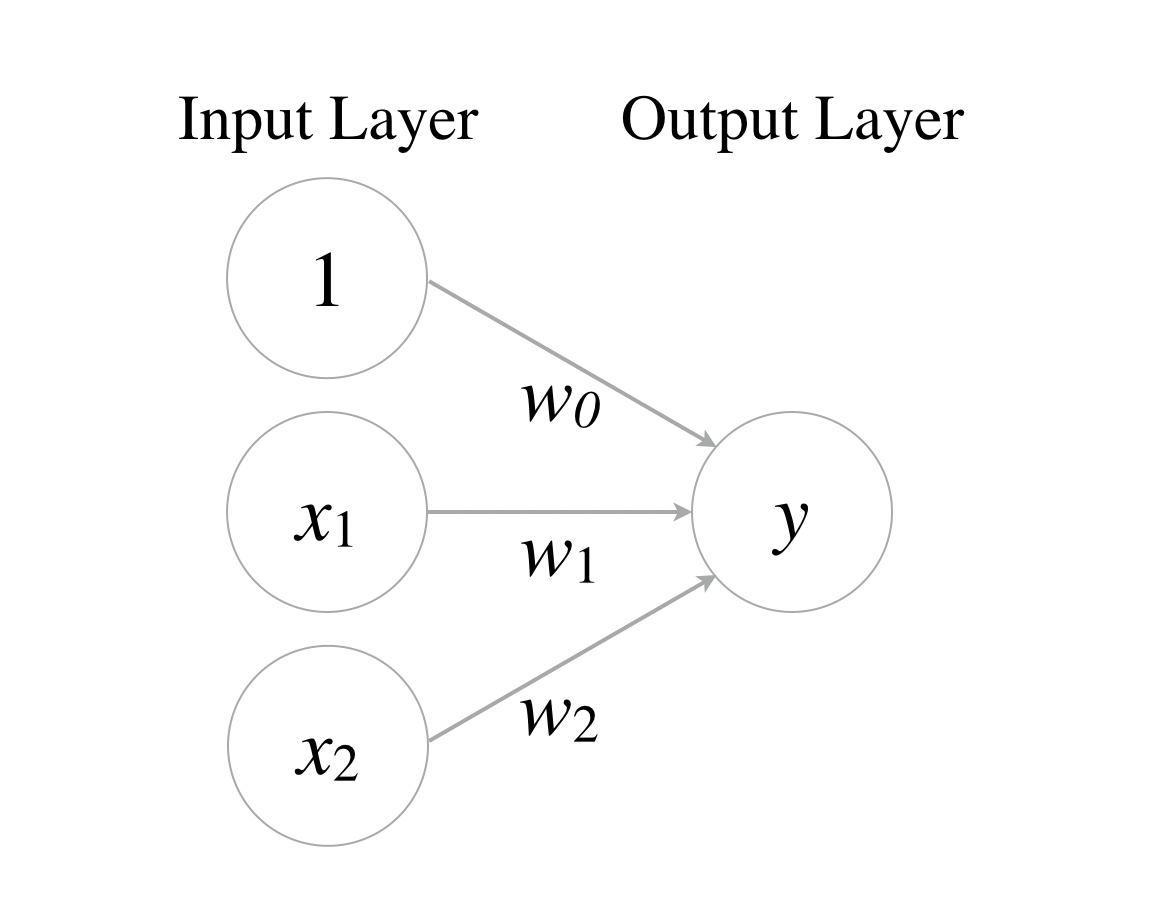
- Simplest form of neural network.
-
What can it compute?
- Linear functions - where output groupings (true or false) can be separated by a line.
- E.g. AND - yes; XOR - no

Demo: NN Perceptron in Python
Layered Neural Networks (Deep Learning)

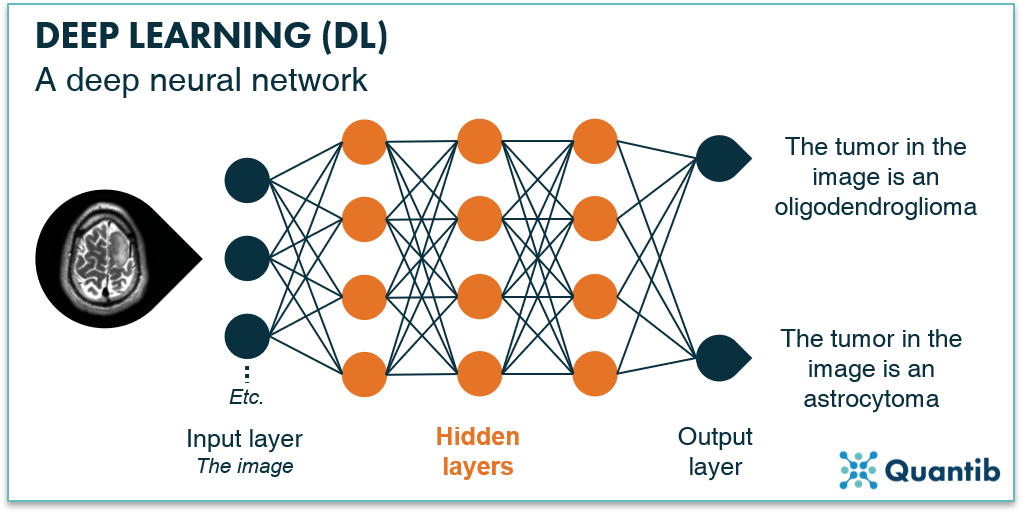
- Add more layers to the network.
- Can compute more complex functions.
Generative AI
What we've focused on so for is classification (e.g. "this is a cat" or "this is a dog").
- Generative AI is a type of machine learning where the model is trained to generate new data.
- The model learns to generate new data that is similar to the training data.
Large Language Models (LLMs) are a type of generative AI that are trained to generate text. There are also models that can generate images, audio, and other types of data.
Industry and Market Considerations
GPU Market and Compute Resources
-
Current State
- nVidia dominance and supply constraints
-
Currently linear relationship between compute investment and model
performance
- E.g. 10x larger model -> 10x model performance
- This is slowing down
-
Future Challenges
-
Potential "AI bust" scenario for industry
- Similar to dot-com bubble
-
Potential "compute bust" scenario with limited compute
resources
-
US effort:
Stargate Project
- $500 billion US project
- Energy infrastructure
- AI hardware
-
US effort:
Stargate Project
-
Potential "AI bust" scenario for industry
Challenges and Considerations in AI
Technical Challenges
- Input encoding methodologies
- Computational limitations
- Model scaling issues
Ethical and Regulatory Considerations
-
Data Rights and Ownership
- Open vs closed source models
- Training data ownership and sale of data
- Data storage and sovereignty
-
Ethical Implementation
- Training data bias and representation
- Data labeling practices
- Fair use of artistic and research works
-
Responsible AI deployment
- Example: Ethics of AI in hiring practices (facial recognition)
-
AI Safety
- Human initiated: Avoid nuclear, biological, chemical, social engineering, autonomous weaponry, cyber warfare
- AI evolution: AI alignment to human values in case of autonomous AI
- US has chosen not to join EU level of regulation for AI
-
Long Term Cognitive Impact
- Code quality issues for generated code
- Decreased critical thinking skills for AI "power users" (over-reliance on AI)
- "Groupthink" perpetuated by AI, as it generates feedback loops of similar responses (possibly from itself or other AI)