Networking Communication Patterns
Communication Timing Patterns
Synchronous

Definition
A pattern where both parties communicate in real-time with minimal delay.
Characteristics
- The connection is alive for the duration of the conversation.
- Both parties are "waiting" for the other to respond; they do not do other work while waiting.
Examples
- Phone calls
- Video conferencing
- Some chat systems
Asynchronous

Definition
Parties do not need to be available at the same time; messages can be stored and retrieved later.
Characteristics
- The connection is not alive for the duration of the conversation.
- Messages can be stored and retrieved later.
Examples
- SMS (text messages)
Communication Models
Client-Server
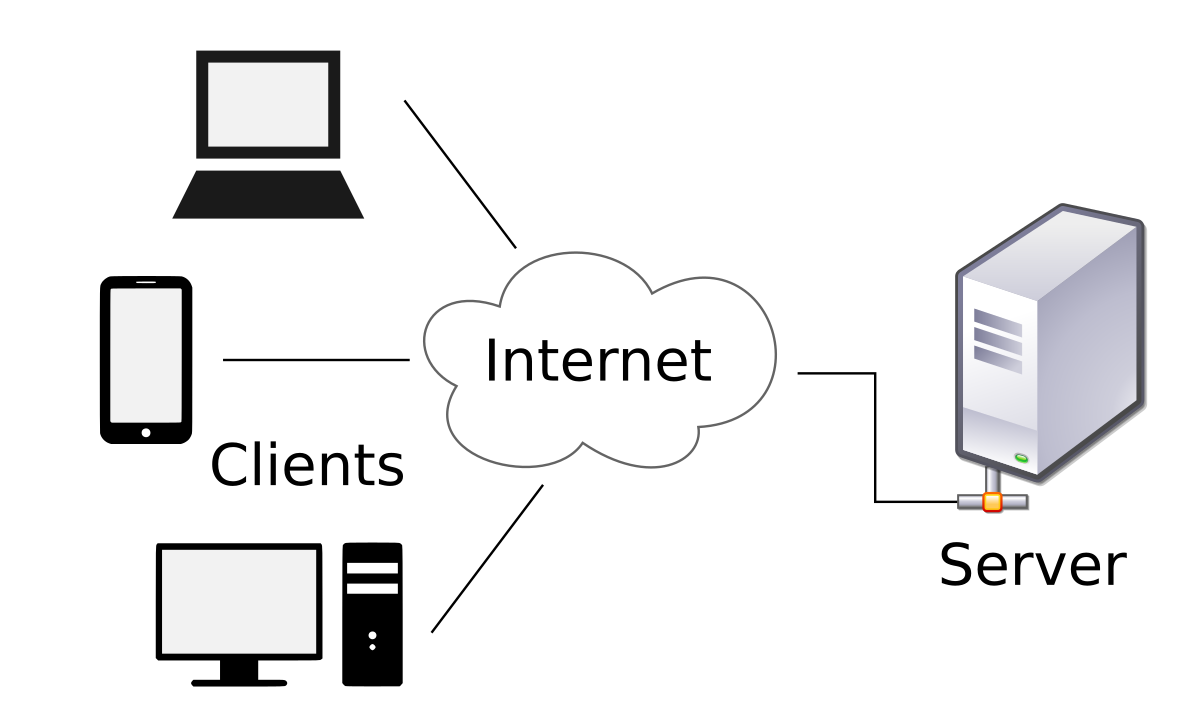
Definition
A model where one device (the client) requests resources or services from another device (the server).
Characteristics
- Many clients may connect to one server
- Clients initiate requests; servers respond
- Centralized control (server manages resources)
- May be async or sync
Examples
- Web browsing (browser = client, web server = server)
- File downloads
Peer-to-Peer (P2P)

Definition
A model where each device (peer) can act as both a client and a server, sharing resources directly.
Characteristics
- No central server
- Peers connect directly to each other
- May be async or sync
Examples
- File sharing (e.g. BitTorrent)
- Video conferencing (e.g. Zoom)
- Chat applications (e.g. Discord)
Data Exchange Patterns
Assuming the server has some data that the client needs, there are four main patterns for how the client can get that data:
| Pattern | Initiator | Connection Type | Timing | Use Cases |
|---|---|---|---|---|
| Active Connection | Both | Persistent | Sync/Async | Chat, streaming, online gaming |
| Push | Server | Persistent/On-demand | Async | Push notifications, live updates |
| Pull | Client | On-demand | Async | Web browsing, API requests |
| Polling | Client | Repeated | Async | Email checking, software updates |
Persistent Connection

Definition
A connection that remains open for the duration of the communication, allowing data to be exchanged at any time.
Characteristics
- The connection stays alive for the entire session.
- Can support multiple messages in both directions.
- May be synchronous or asynchronous, depending on implementation.
- Enables real-time or near-real-time communication.
Examples
- Real-time chat applications (e.g., instant messaging)
- Streaming media (e.g., video/audio streaming)
- Online gaming
- WebSockets
Push

Definition
The server sends (pushes) data to the client as soon as it becomes available, without the client needing to request it each time.
Characteristics
- The server initiates data transfer to the client.
- The client passively receives updates.
- Typically asynchronous communication.
- Efficient for timely updates.
- Good for broadcast (one to many) communication
- Good for event driven communication
Examples
- Mobile app push notifications
- Server-sent events (SSE) in web applications
- Live sports score updates
- Weather alerts
- Phone lockscreen "widgets"
Pull

Definition
The client requests (pulls) data from the server whenever it needs information.
Characteristics
- The client initiates each data request.
- The server responds only when requested.
- Asynchronous communication.
- Suitable for on-demand data access.
Examples
- Web browsing (loading a webpage)
- API requests (fetching data from a server)
- Downloading files
Polling
Definition
The client repeatedly requests (polls) the server at regular intervals to check if new data is available.
Characteristics
- The client sends requests on a schedule (e.g., every few seconds).
- The server responds with new data if available.
- Automated, repeated form of pull.
- Asynchronous communication.
- Can be less efficient due to repeated requests.
Examples
- Email clients checking for new mail
- Applications checking for software updates
- Chat apps without real-time updates
Protocols Introduction
Protocols are standardized rules for communication.
In each of the above patterns, the client / server may send messages back and forth to coordinate the transfer of the payload (the actual data being transferred).
- Rules for how to establish a connection (handshake)
- Rules for how to break the connection (teardown)
- Address of the sender and receiver
- Type / format of payload (html, image, video, etc.)
- Data about the payload (size, compression, encryption, etc.)
:max_bytes(150000):strip_icc()/tcp-headers-f2c0881ea4c94e919794b7c0677ab90a.jpg)
The TCP header format specifies how the computer should interpret the information. Each field has a set length, position, and purpose.
If the standard was not followed exactly, the data would be misinterpreted.
Paper Airplane Protocol
You have developed a paper airplane mode of communication, that you would like to use to serve song lyrics to your friends.
The server, a computer, is very literal. It uses an algorithm to understand the message that was sent, and responds using the same format.
Packet Number
Sender Address
Receiver Address
Action
Payload (text data to be transferred)
Data Length (character count of the payload)
Checksum (md5 hash of the payload)
Diagram
Paper Airplane Protocol - DrawIO
Client
Request
1
Desk 4
Desk 11
Get Lyrics
Beatles;Yellow Submarine;Yellow Submarine
41
666180b3e449222c2241b2afe32bfca3
Server
Response
1
Desk 11
Desk 4
Data Transfer
In the time that I
18
9eceaa495884413082c94280d965738e
2
Desk 11
Desk 4
Data Transfer
was born, lived a man
21
690c8054749a1cb7fb448c5804613dc33
Desk 11
Desk 4
Data Transfer
in a submarine. ^ENDMESSAGE^
28
0582957562b0492f8ad2aa0807ea1154The OSI Model
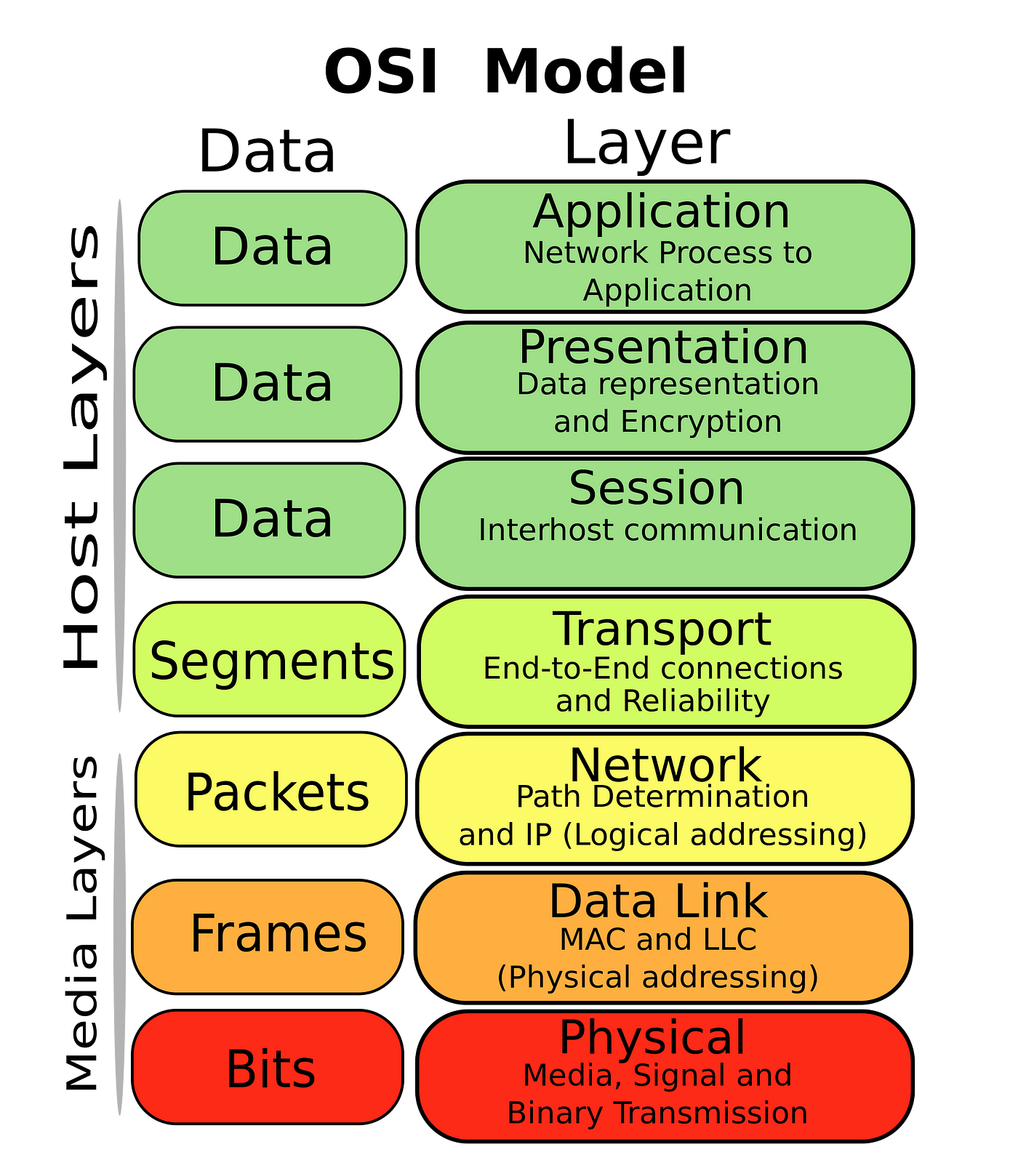
Each layer of the model encapsulates information from the layer beneath it, and adds information relevant to the layer above it.
This makes a "sandwich" of information, with the outermost layer being the application layer, and the innermost layer being the physical layer.